
Why Paint?
On the unvitality of art, the gap between press release and painting, & the problem of form and content, w/ reference to Diva Corp's Insta-Essay and paintings by Doron Langberg and Cynthia Daignault


Published in Perseity Art Review on April 12, 2026.
—
Recently Diva Corp posted on Instagram
It’s 2026, you’re an artist, you can do anything… Why paint?
knowing, of course, the question would provoke responses both fanatical and flippant. Putting the substance of Diva’s question aside for now, it was briefly entertaining to compare the comments of worked-up painters with the paintings they posted, to see whether paintings made by writers of woo-woo justifications were vaguely mystical, those of the politically oriented were rhetorical, and those of the pedantic, academic—in short, to see whether there was any coherence between claim and work. The novelty of this comparative study wore off before I discovered any such coherence and my doomscrolling, thinly veiled as research, left me disappointed by predictable comments and predictable paintings, impatient with the discrepancy between what the painters claimed about painting and the so-called works they put their names on—
an impatience familiar to any gallery-goer in the form of the gap between the claims made by press releases about paintings and what the paintings themselves are actually doing (or, what is more often the case, failing to do).
This gap between press release and painting—and our complacency—no, our expectation of it, is a symptom of what can only be a shared suspicion that painting is on its own incapable of expressing anything relevant to the time we live in.
Words, we thus feel, are necessary to explain what a painting is about, to clue us into the relevant context, conceptual framework, underlying “research,” artistic intentions, etc., etc., etc., without which, we seem to worry, we would find ourselves staring blankly at colored paste spread across a surface.
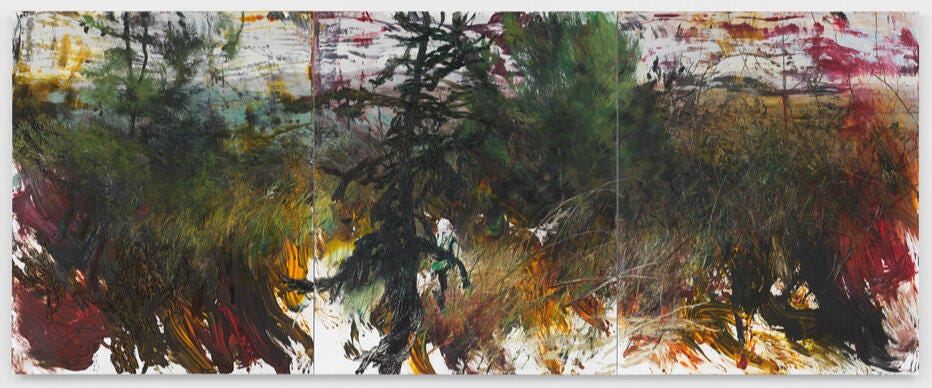
How, after all, could I know that this otherwise inoffensive landscape painting actually “[makes] visible the violence” of Israelis against Palestinians if I didn’t read the accompanying essay?
Well—I couldn’t, because it doesn’t actually make it visible if words are needed to explain it.
After spending more time reading the essay than looking at all of the paintings cummulatively, the chasm between claim and art object gapes so wide one can’t help but feel that the gallery must think us schmucks if they expect us to believe that a painting of a patch of shrubs, perfect for the wall of a millionaire’s living room, can make visible what two and a half years of on-the-ground footage of unbelievable atrocities can’t seem to succeed in making us see. All due respect to the artist’s struggle to understand their history, their contingency, and the implications of the moral revelations they’ve undergone over the past years. But the work on view does not do the work they claim it does.
In the face of such impotence, it’s no wonder that critics repeat the cry—“From today, painting is dead!”—first uttered in 1839 by Paul Delaroche upon seeing a photograph of the man whose portrait he was laboring over, announced again in 1958 by Allan Kaprow after Jackson Pollock’s literal death, argued again in 1981 by Douglas Crimp at painting’s seeming resurrection after the conceptual production of the 60s and 70s. Each proclamation, though similar in form, makes a different claim, grounded in different assumptions, different definitions of art and painting. Delaroche’s presumption that painting’s end was mimesis meant that photography made it technically obsolete. Kaprow’s understanding that painting’s end is expression meant that there was no reason for art to be limited by the conventions of fine art. Crimp’s belief that modernism was over meant that painting ought to be seen for what it really is, namely, paint applied to a support essentially no different from that applied to facades and signs, save the ideological support of galleries and museums.
Today, the charge is repeated by Diva. And by you, too, if you managed to snag a Why paint? shirt from the Diva Corp merch store before it sold out, Diva’s call for new forms (all comments included) printed in minuscule text on a white tee—an expression, in the characteristic quasi-irony of whatever stage of capitalism we’re in, of our sense that we, as a culture and society, are stuck.
Challenges to content are terminal and easily reduced – that was clear last decade. They fit neatly into the neoliberal regimes you guys love to hate: Quotas can be met, “evolution” pointed to… and the sale can still be made.
Challenges to form, however, have no end. (Thinking of Callois’ distinction, here, between play and games). With each challenge comes another… until that becomes the norm. Break form enough and prismatic shifts will follow.
I sympathize. Only something dead would require as much verbal scaffolding as these paintings do to convince us they’re animate.
But this sense of art’s unvitality and the symptomatic gap between words and work is not peculiar to painting as a medium, as Diva claims it to be in their Insta-essay, which hinges on a facile distinction between form and content (a weak hinge, indeed, as we’ll see later). Gallerinas across the country hand out multi-page press releases “about” works of all media, whether “traditional” or “new”: veritable five-paragraph essays, single-spaced and in 12-point font, peppered with vague verbs (explores, delves, interrogates, questions, subverts, analyzes, expresses) and abstract nouns (society, culture, gender, oppression, convention, late capitalism, the post-digital/-modern/-human/etc.)—a whole lotta verbal machinery intended to convince us (and, we suspect, themselves) that the artwork is actually doing something.—And, in their desperate attempt to convince, acknowledging that it, indeed, does not.
The sense that art is impotent knows no medium-specific bounds.
So, Painters, forgive us when we use your medium as an exemplar of a pervasive impotence. It’s an easy target because so close to mere luxury good and so often allowed by its maker to collapse into commodity. Know that it’s not you, it’s us—all of us. Including you. If art is to remain vital, the gap between what is said about it and what it does in experience must be closed. This is not a problem of medium, but of form—two terms too often confused—but we need some grounding in particular artworks before we can leap to this level of the discussion.
—
I fell, so to speak, into such a chasm while visiting Cynthia Daignault’s show Denali at Olney Gleason last month—an exemplary symptom of a failed faith in painting, unacknowledged and untreated. It exemplifies how anxiety about painting’s relevance can manifest in externalities like conceptual strategies and press releases, without, however, allowing that anxiety to become a productive element in the work itself (which would be the only way to actually make a painting that is vitally relevant to contemporary life).
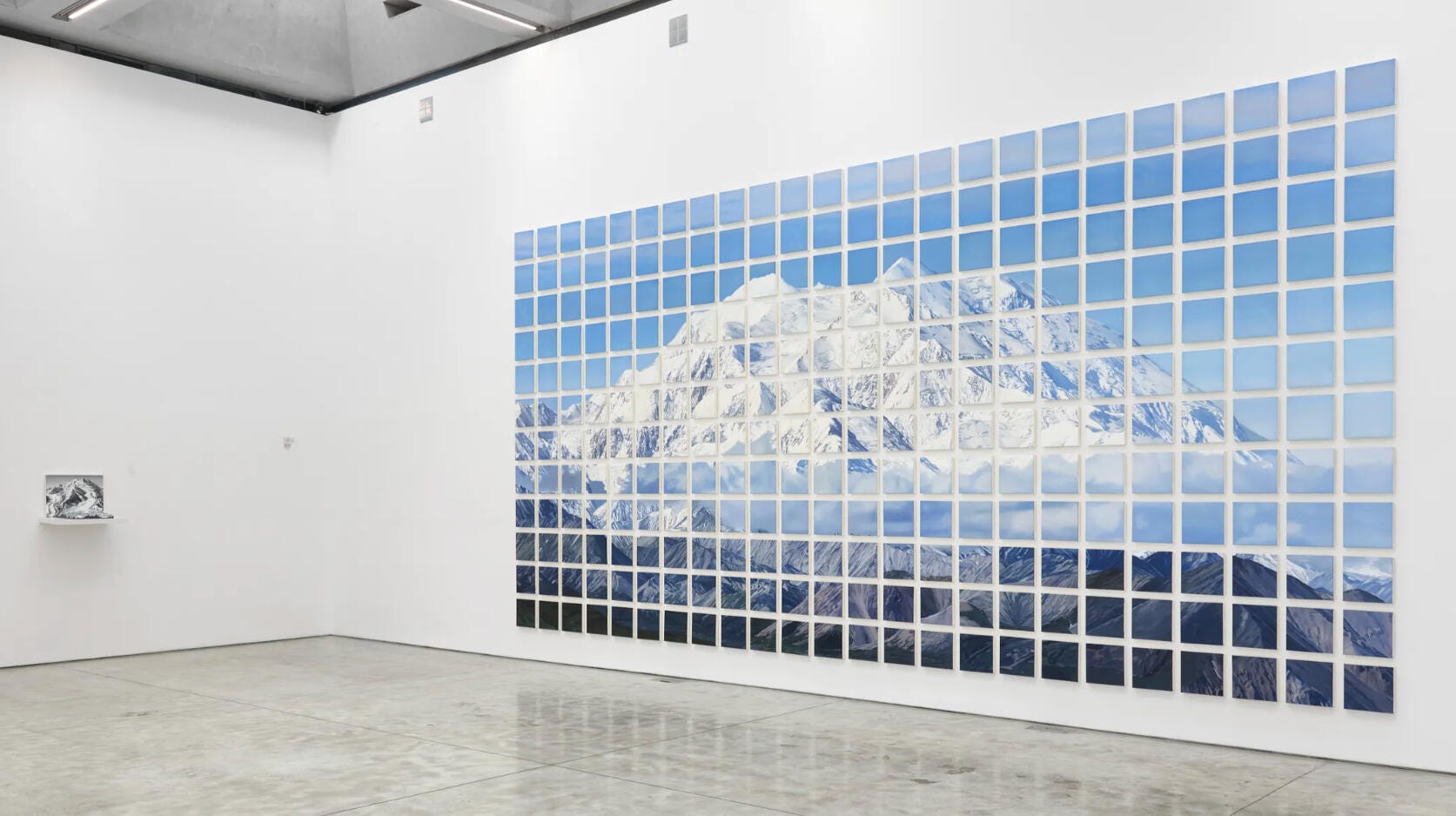
The image of a snowy mountain was repeated across most of the pieces in the show in a variety of media: painting, photography, a 3D topographical model. The non-painting objects seemed mere accessories, overshadowed by the paintings, the largest of which was an array of nearly three hundred 10 x 10-inch canvases organized into a 10 x 20-foot grid depicting a mountain. One gets the sense that Daignault just wanted to daub paint on a canvas, but, suspecting (if not acknowledging this suspicion) that such daubing is not enough to make a painting today, resorted to conceptual strategies: external frameworks that inform the painting without being reciprocally informed by act of painting itself—producing, in short, sophisticated paint-by-numbers. A large painting is constructed out of small square canvases, like a grand Instagram grid or photo album. The same image is reproduced across different canvases, slight material differences asserting the individuality of paintings in contrast to identically reproducible digital images. Brushstrokes are left unblended, retaining their individuality as the painterly correlate to pixels. Why these paintings are of mountains is unclear. Any digital image would have sufficed, so unnecessary is the connection between how they’re made and what they’re of.
This thorough conceptualization chops up the artwork, which is nothing if not a unity, into what might lazily be called a content (the image of a mountain, arbitrary because it could be swapped with any image of anything) and a form (the conventions of painting modified by digital analogy).
A distinction alien to artworks—for art works only when there is no distinction between form and content, when what the work is about is what the work is doing (which by no means requires that art has to be about art). The “form” proper to an artwork is so intertwined with its “content” that it can’t be separated from it.
But when grasping for words to describe such failures, it’s understandable to turn to such a familiar but unexamined distinction as that between form and content, the visible object and what it’s allegedly about. This distinction seems adequate precisely because we’re so used to the gap between the object and what the artist or gallery claims it’s doing. We take them at their word that the content is something that we can’t get from the object and is therefore distinct from its physical form. So we understand why a critic who wants more from art, like Diva, who clearly hasn’t articulated to themselves what a form is, would, upon experiencing so many bad paintings (they abound), conflate form with medium. The erroneous step
is thus taken: all, or at least most, paintings are impotent, therefore painting must be incapable of making vital forms.
It is clear that you can’t have a form without the medium in which the form is realized. But it is just as clear that you can have the latter, a specific medium, without the former, a form—that any medium can fail to produce a vital form, in which case, it fails to be an artwork.
As is the case with Daignault’s paintings. The paintings themselves presuppose that painting is a generic form that gets filled with arbitrary content. The content, in this case, a mountain, which, when we turn to the press release (as we always do when a show is disappointing), we are told is Denali (a.k.a. Mount McKinley):
“meaning ‘The Great One’, is the highest peak in North America and a contested symbol of American exceptionalism, white supremacy, and frontier mythology. The mountain also stands as a grand reminder to the existential threat of climate change, a theme which weaves throughout the show. As Arctic regions are warming at a rate four times faster than the global average, the mountain is simultaneously a symbol of our country’s majestic wilderness and of its impending collapse.”
…
I envy you, Reader, who can chuckle safely behind your screen at these absurd claims. Scoffs, let me tell you, reverberate loudly in the cavernous space of that gallery, making it a tempting place to let echo the cry that is always on the tip of my tongue when I taste such baloney: that this is proof, indeed, that painting is dead.
But I swallowed it. For I have seen contemporary paintings that are alive, and paintings from the past that retain their vitality. It doesn’t matter that most painting—most art of any medium—is mediocre, nothing, mere decoration, academic pretension, rhetoric, illustration, nonsense. Good art is always an exception.
What is dead, however, is symbolism, and with it the fantasy that meaning in an artwork can be grasped immediately through mere visual images. We—those of us who belong, however begrudgingly, to the cosmopolitan artworld—do not live in a world of symbolic thought. Ours is not a tightly-knit social structure of shared assumptions, the ground that allows an image to function as a symbol that directly communicates another idea.
An image is not a symbol if its meaning has to be explained in a press release. A few sentences cannot make a painting of a mountain about white supremacy.
The Reader won’t be surprised that an artist as inclined to letting words do the work as Daignault would respond verbosely to an inflammatory post like Diva Corp’s—but they may be surprised, as I was, by the terms the painter used. A new chasm opens up. In contrast to the quasi-conceptual angle of the press release, with its claims about the digital, environmental, and social, Daignault’s “hard respectful disagree” to Diva’s denunciation of painting conjures a numinous picture of the undertaking:
‘Painting’ is a sacred human practice present across every world culture since the very beginning of human history, in all cultures at all times. To engage in a practice as primal as sex or picking berries is to join the long flow of human thought history. I reject your false capitalist notion of “progress” (bigger, better, new!) in favor of a sacred practice routed [sic] in universal humanism. A practice at its core about the bonding of consciousness and body - eye and hand.
The “primal” “practices” of sex and berry picking didn’t, I don’t think, need press releases to make their meanings clear (though humankind might have benefited if we had one explaining the former). Even to one, like myself, who grew up in the city and has never picked a berry, the intention behind such an undertaking is evident—namely, to procure food for necessity or pleasure. In contrast, what would the intelligibility of Daignault’s paintings become in the “long flow of human thought history” if the press release explaining that these depictions of a mountain are actually about white supremacy were ever lost? Without the words that provide their content, they would be revealed as formless, mere artifacts of human activity, of anthropological, not artistic, interest.
Prehistoric cave painters didn’t need press releases to explain their work, even if we, in our non-symbolic mode of life so alien to theirs, wish they’d left them for us when we anachronistically project our understanding of art onto them. We do not know the so-called content of Altamura cave paintings and because of this—because the two are not separate—we don’t know their form. The interest we can take in these so-called paintings is anthropological, not artistic.
It is worth asking, as does one of the aforementioned proclaimers of painting’s death: what enables us to say that a cave painting, a 17th-century court painting, and an abstract expressionist canvas all belong to the same category? These very different objects can be grouped together only if we understand painting as a transhistorical, medium-specific undertaking, an essence that is modulated only superficially over time by styles and technological developments. It is this picture of painting that allows Diva to conflate medium with form.
But, nearly fifty years after it was asked, the question, rather than proving, as the theoretical pallbearer had hoped, the necessary irrelevance of painting, shows that once we’ve accepted that these painted objects are so different, we need not group them together as belonging to an artistically relevant category. So today I proclaim:
Painting as an artistic category is irrelevant. We don’t care about its development or lack thereof, its transhistorical relevance or lack thereof. All we care about is the creation of new forms.
It is more than clear that not all paintings succeed in producing new forms. But it is just as clear, by their dependence on press releases and our dissatisfaction with them, that so-called artworks in other media don’t necessarily succeed in producing new forms. In a time when art can be in any medium, we must recognize that the achievement of a new form is more complicated.
A work that fails to become a new form doesn’t merely reproduce a dated form: it fails to achieve form at all.
I’m not going to pretend to solve the form/content problem that has plagued philosophies and theories, it seems, since their beginning. I offer only a provisional definition of an artistic form, a starting point so we can begin to free ourselves from the deadlock of form/content optimism/despair, one that gives artists, viewers, and critics alike the traction to keep moving forward:
An artistic form is an artwork: a singular individual that struggles toward coherence within itself, growing out of and surpassing the initial givens—generic and therefore open to unknown possibilities—of medium, time, and place. They are syntactic: coherences inseparable from the relation of parts to whole, indivisible into false dichotomies like form and content. There are as many artworks as there are forms. And there are many things called artworks that are not because they fail to achieve their form.
With this picture of form, Diva’s call for new forms, in its generic medium-specificity, starts to look like a wish for a symbol, some visual element of an artwork that immediately communicates the idea of newness—a picture of newness beholden to a dated picture of a public shocked by abstract art or a urinal. But in an age where anything goes, when we don’t share assumptions about art except that it can be anything, such symbolic communication is not our fate.
Communication today is not symbolic: implicit, condensed, based on shared assumptions. It is syntactic: elaborated, explicit, its articulation and reception not given. The communication and grasping of meaning must be worked for. New forms, too, must be elaborated and syntactic. Their creation and reception must be worked out by both maker and viewer: given interpretations overcome, parts related to a whole that only gradually comes into view, meaning discovered. After all, we don’t just want the idea of newness—we want new forms.
The step away from death for art in general, toward form, must be taken step-by-step. As artists work to make forms (which must be done anew with each artwork), as we learn to see them (which must be done with each viewing), we may find ourselves working toward a shared, better form of life. The only way out is through.
None of this should be taken as a comfort for painters, nor any other type of artist, nor any critic. We all have a lot of work to do. As Diva says,
We’ve got miles to go before we sleep.
 | A guest post by
|
I like this
Why paint? Perhaps it's a question without an answer, at least not one that justifies painting – born only from the pleasure of doing it, in the belief that the simple is preferable to the complicated, without the expectation of what it might become, and existing without a plan for how it will become useful to others (others will find a solution for that). Or an answer that doesn't consider what the artwork becomes after leaving the painter's hands, a field of extraneous ideas focused on what lies beyond the work. Is that why things fail? In any case, the question can be reformulated – Do we need to relearn how to see art? Perhaps it would help if we weren't constantly under an avalanche of such a quantity of information and images.